
Why I Continue to Manage My Own Website

Starting a website is not that difficult these days.
You choose a hosting package, install WordPress, and you can get started almost immediately.
For many people, that is exactly what they need. No hassle with servers, updates or complicated settings.
Still, I choose to manage as much of my website myself as possible.
Not because it is always easy.
But because I find it interesting to understand what happens behind my website.
What Actually Happens Behind a Website?
When you open a website, you usually only see the page in front of you.
There is much more going on behind that page.
You need a server.
You need storage for files.
You need a database to store information.
You need software to make everything work together.
And, of course, the connection must be properly secured.
I find that whole process interesting.
I do not just want to know that my website works.
I also want to understand, at least to some extent, why it works.
My Website Runs in My Own Environment
My website is not separate from my other technology.
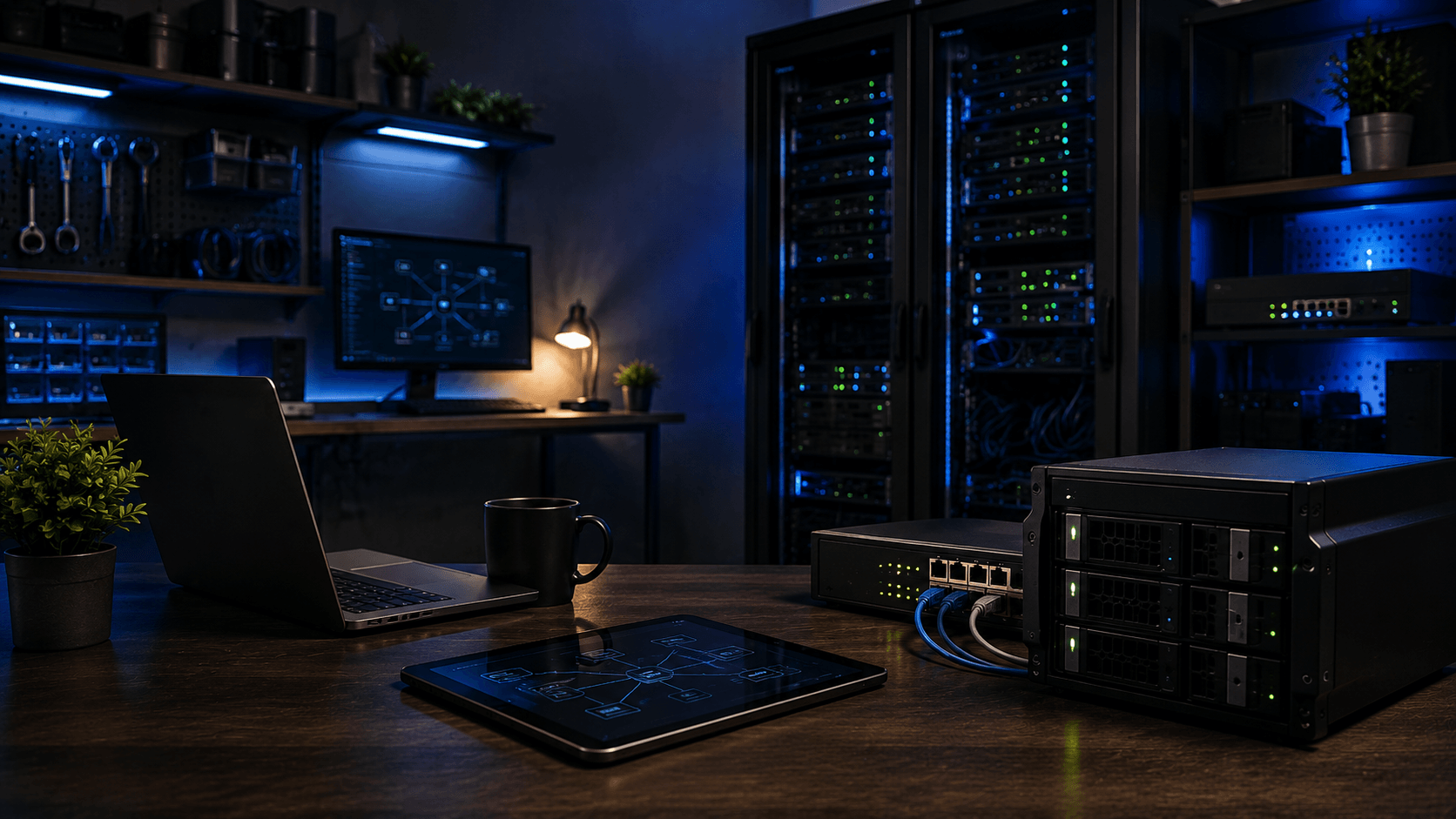
It has become part of my homelab.
There, I use different systems and programs to make everything work together.
Linux, Nginx, MariaDB and WordPress are examples.
For someone who has never worked with them, these might sound like complicated technical names.
For me, they are simply different pieces of the same puzzle.
And by trying to put that puzzle together myself, I keep learning more.
In my earlier article, Web Hosting & Open Source, I explained why I chose this way of working.
Managing It Myself Also Means Figuring Things Out Myself
Of course, there is a downside.
When you manage everything yourself, you cannot always call someone who will solve the problem for you immediately.
When something goes wrong, you first have to work out where the problem lies.
It could be an incorrect setting.
An update that has changed something.
A web server problem.
A security setting.
Or something you did not even know existed beforehand.
That can be quite frustrating.
But in the end, I also find it interesting.
When you eventually discover where the problem is, you have not only solved it.
You have also learned something.
I Do Not Have to Know Everything Straight Away
In my situation, that would not be realistic anyway.
Since my stroke, things no longer move as quickly as they used to.
Sometimes I need more time to understand something.
Sometimes I have to read something again.
And sometimes I notice that my energy has run out and that it is better to take a break.
I try to take that into account.
I do not have to finish everything in one day.
I can continue tomorrow.
That may be one of the most important things I have learned over the past few months.
Taking It Step by Step Works for Me
When I work on my homelab, I try to take small steps.
First, understand what the problem is.
Then make one change.
After that, test it.
And only when everything works properly do I move on.
That may sound simple, but it prevents me from changing too many things at once and then no longer knowing where the problem came from.
It also gives me peace of mind.
And peace of mind is important to me.
Sometimes I Simply Need Help
Managing things myself does not mean that I have to do everything alone.
When I cannot work something out, I look for information.
And sometimes I ask for help.
Recently, for example, I did this with my Sophos Firewall.
I encountered a certificate problem and could not immediately work out why it was not behaving as expected.
That is why I contacted Sophos Support.
I do not mind that at all.
Asking for help does not mean that I cannot do something.
It means that I want to make progress.
My Homelab Is Also a Learning Environment
That is really what makes my homelab so valuable to me.
I can try things out without everything having to be perfect.
I can test a different solution.
Reuse an old device.
Make a mistake.
And then start again.
That fits well with how I look at technology these days.
I do not have to get everything right straight away.
Above all, I want to understand what is happening and keep making progress.
That is also why I wrote the article Do You Have Any Tips or Ideas for My Homelab?
In it, I explain what I still want to experiment with and why even an older device can be interesting to me.
Old Hardware Does Not Have to Be Discarded Straight Away
I also think it is a shame to write off good hardware without a reason.
That is why I also use older devices in my homelab.
A server does not have to be the latest model to be useful to me.
If it still works and is suitable for its purpose, it can often continue to be used perfectly well.
For learning.
For testing.
Or simply to run a service.
That is also why I would find it interesting to compare different devices side by side.
Not to replace everything straight away, but to discover why one device behaves differently from another.
Perhaps someone has an unused firewall or another network device lying around.
Even an older device could be interesting to me, if only to experiment with it and learn.
It certainly does not have to be a new or expensive device.
Open Source Fits Well with This Approach
Much of the software I use is open source.
I find that interesting because it means you are not completely dependent on a single provider.
But for me, it is mainly about the freedom to learn and manage things myself.
I certainly do not need to know what every line of code does.
It is already valuable to me to understand which components I use and how they work together.
I keep learning more from that.
It Does Not Have to Be Perfect
My website and my homelab are never really finished.
There is always something to improve.
An update.
A new idea.
A problem that needs solving.
Or a device I want to experiment with.
In the past, I might have thought that something was only good when it was completely finished.
Now I see things differently.
A project can grow.
A website can change.
And I can investigate things again.
All of that is part of the process.
What My Recovery Has Taught Me
My recovery and technology might seem like two different worlds.
But for me, they have become increasingly connected.
The same things apply to both:
You do not have to be able to do everything at once.
You are allowed to make a mistake.
You are allowed to start again.
You are allowed to ask for help.
And sometimes you are allowed to stop for a while.
After that, you can continue.
I try to apply that to my website as well.
That Is Why I Continue to Do It Myself
I continue to manage my own website because I enjoy it.
Because I want to understand what is happening.
Because I enjoy learning.
Because I like reusing old hardware.
And because my homelab gives me a place to keep discovering new things.
For me, it is not about finding the fastest solution.
It is about continuing to learn, understand and make progress step by step.
That applies to my technology.
But really, it also applies to my recovery.
How Do You Do It?
Perhaps you manage your own website, server or other technical system.
Perhaps you deliberately choose a hosting provider because you do not want to worry about any of it yourself.
Both choices are perfectly fine.
I am mainly interested in your experience.
Do you manage anything yourself, and what do you find most enjoyable or most difficult about it?
For me, not everything has to be finished today. I am mainly glad that I am working on things again, can keep learning and can make a little progress at my own pace.
And sometimes it is simply good to take a quiet moment to look at what has already gone well.